Kubota to Launch Unmanned Autonomous Tractors with Remote Monitoring Capabilities Contributing to Further Labor Savings, Reduced Workforce Requirements, and Greater Efficiency in Japanese Agriculture
August 6, 2026
Kubota Corporation
Kubota Corporation (Head Office: Kita-ku, Osaka; President and CEO: Shingo Hanada, hereinafter “Kubota”) announced that it will launch the new Agri Robo Tractor MR Series (unmanned and manned models) in April 2027 in Japan.
The unmanned models’ remote monitoring function allows users to leave the worksite and devote their time to higher-value activities, such as other tasks and farm management decision-making, while the tractors perform agricultural tasks autonomously.
These are the first domestically manufactured tractors capable of unmanned autonomous operation under remote monitoring (as of August 6, 2026, according to Kubota’s research).
Kubota works to address labor shortages, difficulties in securing skilled workers, and other challenges facing agriculture through the development and provision of smart agriculture solutions, including unmanned autonomous operations, in order to contribute to enhancing the sustainability of Japanese agriculture.
*There are no plans to sell this product in any country or region outside of Japan.
-
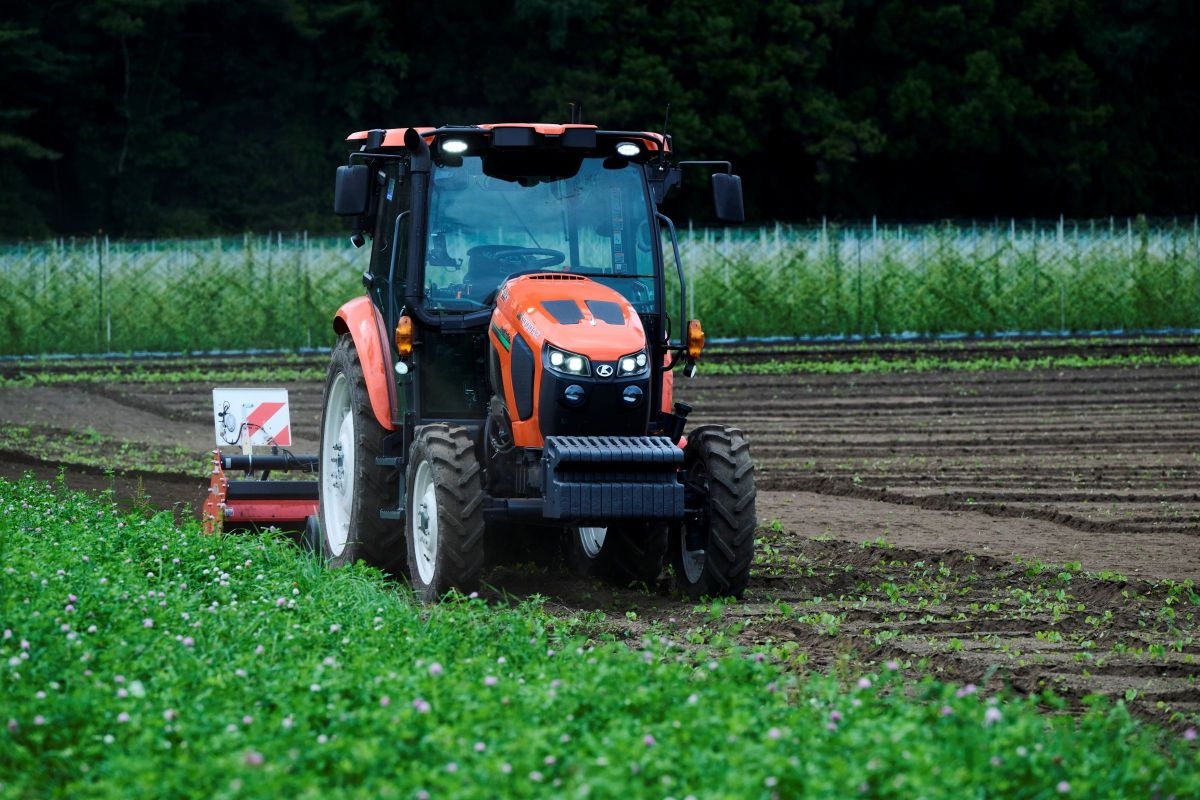
Unmanned Autonomous Tilling Operation (Unmanned Model)
1. Background and Objectives
- The Ministry of Agriculture, Forestry and Fisheries of Japan is leading initiatives to promote smart agriculture with the aim of addressing labor shortages in Japanese agriculture, caused by an aging farming population and farmers leaving the industry. Robotic agricultural machinery, one of the key pillars of these initiatives, has already been put into practical use in unmanned autonomous operations under visual supervision, and Kubota sells the three main types of machinery used in rice farming (tractors, combine harvesters, and rice transplanters).
- Unmanned autonomous operations under visual supervision have enabled labor savings as well as a high degree of precision in the execution of tasks regardless of operator skill levels. However, operators have not been able to leave the vicinity of the agricultural machinery during such operations. To further reduce the need for personnel and address labor shortages, there has been growing demand for the practical implementation of technology that allows agricultural machinery to be operated without users remaining nearby. In March 2024, the Ministry of Agriculture, Forestry and Fisheries of Japan expanded the scope of its Guideline for Ensuring Safety of Automated Agricultural Machinery and established requirements for automated operations through remote monitoring (unmanned autonomous operations) for robotic agricultural machinery.
- Kubota’s new Agri Robo Tractor MR Series complies with the Guidelines. In addition to performing agricultural tasks, the tractors automatically detect people and obstacles, assess potential hazards, and perform emergency stops to avoid danger. Through remote monitoring, users are able to check conditions around the tractors and restart them or issue other commands via a tablet device, without having to return to the worksite, even in the event of an abnormality. The system reduces staffing requirements by freeing users from the need to monitor operations from nearby, and further expands the benefits of introducing unmanned autonomous operations.
2. Product Features
(1) Remote Monitoring (Unmanned Models Only)
- During unmanned autonomous operations, the tractors are connected to a remote monitoring tablet via a cellular network. With the tablet, users are able to check conditions around the tractors and issue commands to start or stop unmanned autonomous operations.
- In the event of an abnormality, such as a tractor coming to a halt, an alert is displayed on the tablet. Alerts can also be sent by email. Users are able to check conditions around the tractor on the tablet and, if they determine that there is no danger, issue a restart command remotely.
(2) Detection of People and Obstacles (Unmanned Models Only)
- Using AI cameras in combination with millimeter-wave radar enables the system to detect people, obstacles, and other objects in the surrounding area while reducing unnecessary stops caused by false detections .
- The tractors are equipped with five cameras that use AI-based image recognition to detect people in the surrounding area and five millimeter-wave radars to detect obstacles. During unmanned autonomous operations, the tractors work while monitoring conditions in all directions around the vehicle. They immediately come to a halt if they detect a person or obstacle.
(3) Autonomous Operations
- High-precision operations are possible using global navigation satellite systems (GNSS) and real-time kinematic (RTK) positioning correction services.
- When using a tractor for the first time, the user must drive it around the outermost perimeter of the field to allow the tractor to map its shape, after which the tractor plots efficient work routes for autonomous operations. From then on, the tractor operates autonomously based on its stored map.
- If the tractor is parked within the field when autonomous operations are launched, it will autonomously move to the designated work start position.
- Autonomous tilling and puddling operations are possible across the entire field, including areas along the edges*.
- Certain conditions apply to the shape and dimensions of the field.
(4) Wide Scope of Applications (Work Types, Slopes, etc.)
- The tractors are capable of unmanned operations for eight major types * of work in rice and field crop farming. They also plot autonomous operation routes suited to work with field crop implements for more efficient operations.
- The tractors are able to engage in field crop work on slopes of up to 10 degrees.
- The eight types are tillage, puddling, primary tillage, seeding, fertilization, intertillage and ridging, intertillage and weeding, and subsoiling. In addition, manned models are also capable of pest control.
(5) The Lineup Includes Affordable Manned Models
- With a user on board, the tractors can drive and work autonomously, including steering themselves and controlling implements.
This enables even inexperienced users to accomplish high-precision work.
3. Product Overview
- Name: New Agri Robo Tractor MR Series
- Launch Date: April 2027
- Number of Models:
2 Unmanned Models (100, 105hp)
3 Manned Models (80, 100, 105hp)